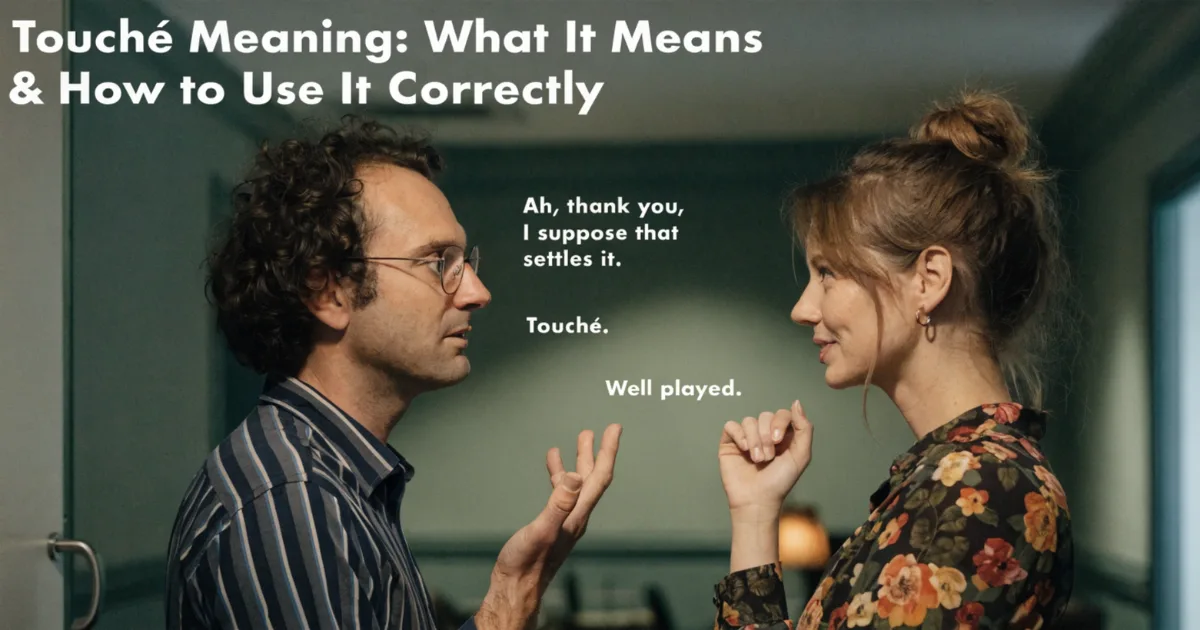
Touché means “well said” or “good point.” You use it to acknowledge that someone just made a clever argument — usually one that catches you off guard.
Simple as that. But there’s a lot more to this word than most people realize.
What Does Touché Mean? (The Simple, Clear Answer)
At its core, touché is an acknowledgment.
It’s what you say when someone fires back with a point so sharp you can’t argue with it.
Not agreement. Not surrender. Just honest recognition that they got you.
Think of it like a verbal nod — “Okay, that was good. I’ll give you that.”
Key distinctions:
- It’s not the same as saying “you’re right”
- It doesn’t mean you’ve lost the argument entirely
- It signals respect for a clever comeback
Americans use it constantly — in debates, friendly banter, interviews, even Twitter threads.
The Origin and History of Touché — From Fencing to Everyday Conversation
Here’s where it gets interesting.
Touché is a French word. Literally, it means “touched.”
It started on the fencing floor. When one swordsman landed a clean hit on their opponent, the referee would call out “touché” — confirming the touch was valid.
Over time, English speakers borrowed it and moved it off the fencing floor entirely.
By the 20th century, it had found a permanent home in everyday American conversation — used whenever someone lands a verbal “hit” just as cleanly as any blade.
Quick timeline:
- Origin: French competitive fencing, 17th–18th century
- English adoption: Late 19th century
- American mainstream use: Mid-to-late 20th century
- Pop culture explosion: TV, film, and social media, 1990s–present
More Poosts:Relentless Meaning: What It Really Takes to Never Give Up
How to Pronounce Touché Correctly (Most Americans Get This Wrong)
Let’s settle this once and for all.
Correct pronunciation: too-SHAY
The accent mark over the “e” is your clue. That little mark — called an acute accent — signals a sharp “ay” sound at the end.
Common mistakes Americans make:
- Saying “TOOCH” (dropping the second syllable entirely)
- Pronouncing it “TOO-chee” (wrong vowel sound)
- Ignoring the accent and saying “touch” flat
Say it out loud: too-SHAY. Stress the second syllable.
Once you hear it correctly, you’ll notice how often people around you mispronounce it.
Real-Life Examples of Touché Used in a Sentence
Nothing clarifies meaning faster than seeing a word in action.
Casual conversation:
- “You always say I never listen — but I remembered your birthday this year.” / “Touché.”
Debate scenario:
- “You criticize social media, yet you posted this argument on Twitter.” / “Touché, fair enough.”
Workplace banter:
- “You said the report was rushed — but it got the client to sign.” / “Touché.”
Pop culture moment:
- Characters in shows like The West Wing, Suits, and House drop touché constantly — always in sharp, fast-moving dialogue where wit is currency.
The pattern is always the same: Someone makes a point. The other person can’t counter it cleanly. Touché is the graceful exit.
Touché vs. Similar Expressions — What’s the Difference?
You’ve got options. Here’s how they compare:
Touché vs. “Well played”
- Both acknowledge a clever move
- Well played feels more casual and game-like
- Touché carries slightly more intellectual weight
Touché vs. “Fair point”
- Fair point is more neutral — it agrees without much flair
- Touché implies the point genuinely surprised you or put you on the back foot
Touché vs. “I stand corrected”
- I stand corrected is a full admission of being wrong
- Touché doesn’t necessarily mean you were wrong — just outmaneuvered in that moment
Bottom line: Touché is the sharpest, most stylish of the three. Use it when the moment genuinely earns it.
More Posts:What “To No Avail” Means: Definition & Usage Explained
When to Use Touché — and When It Just Sounds Pretentious
Here’s the honest truth most articles skip.
Touché lands perfectly when:
- The comeback was genuinely clever or unexpected
- You’re in a playful, witty back-and-forth
- The mood is light and both people are engaged
It falls flat — or sounds pretentious — when:
- You use it too often (it loses all impact)
- The “point” wasn’t actually that sharp
- The conversation is serious or emotionally charged
Tone is everything. Said with a smile and genuine surprise, touché sounds sophisticated. Said sarcastically or too casually, it sounds like you’re trying too hard.
The best rule? Reserve it for moments that actually earn it. You’ll know when that is.
FAQ’s
What is the meaning of touché in English?
Touché means acknowledging that someone made a clever or valid point — especially one you can’t immediately counter. It’s borrowed from French fencing terminology.
Is touché a compliment?
Yes, in most contexts. When you say touché, you’re genuinely crediting someone for a sharp or well-timed argument.
Can you use touché in a serious argument?
Technically yes, but it’s risky. In heated or emotional discussions, it can come across as dismissive. It works best in lighthearted, intellectual exchanges.
Do you need the accent when writing touché?
Strictly speaking, yes — the acute accent (é) is part of the correct spelling. Dropping it changes the intended pronunciation and looks like a typo to careful readers.
Is touché used only in English and French?
It originated in French but is now widely used across English-speaking countries, particularly in the USA, UK, Australia, and Canada.
Conclusion
Touché is one of those rare borrowed words that English kept because nothing else does the job quite as well.
Use it right — sparingly, in the right moment — and it signals both wit and generosity.
That’s the real power of the word. It turns being outmaneuvered into something almost elegant.

As the admin of https://centomags.com, I craft engaging content that brings laughter, heartfelt wishes, and witty pickup lines. My passion lies in creating responses that connect, entertain, and spread joy across every interaction and occasion.