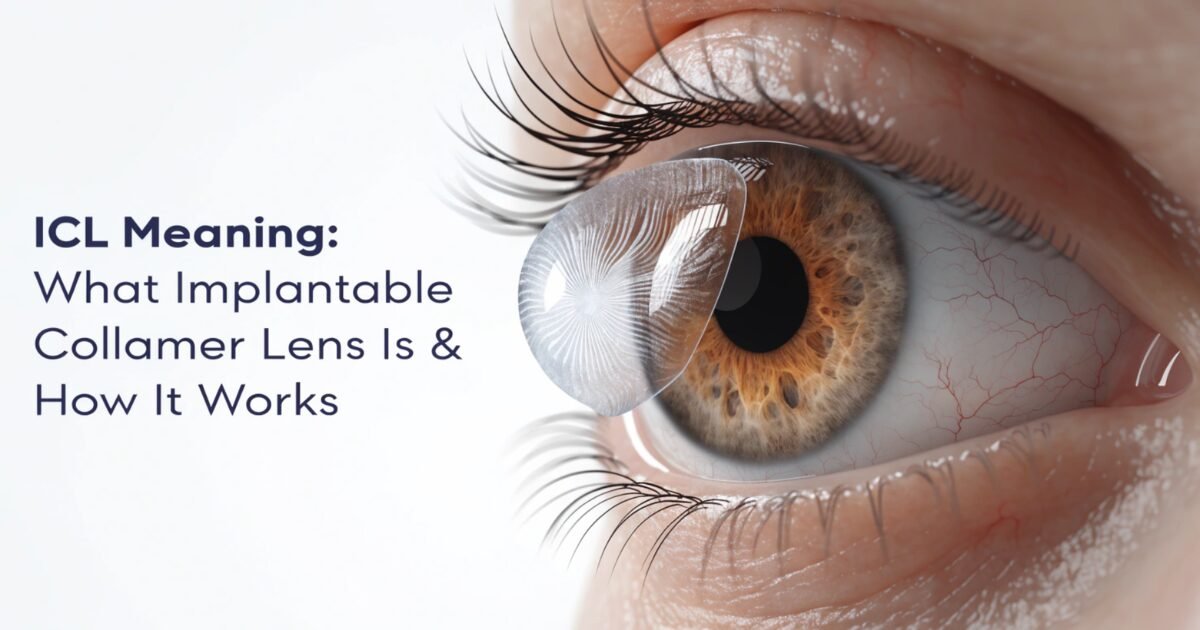
ICL (Implantable Collamer Lens) is a surgically implanted lens placed inside your eye to correct vision problems like nearsightedness, farsightedness, and astigmatism — without removing any corneal tissue.
It’s one of the fastest-growing vision correction procedures in the USA right now, and for good reason.
If LASIK wasn’t an option for you, ICL might just be your answer.
What Is the ICL Meaning and Why Is Everyone Talking About It?
ICL stands for Implantable Collamer Lens.
It’s a vision correction procedure approved by the FDA in 2004, with the advanced EVO ICL version gaining approval in 2022.
The lens is made from Collamer — a proprietary bio-compatible material developed by STAAR Surgical that works in harmony with your eye’s natural chemistry.
Unlike LASIK, nothing is cut away. The lens is simply added inside your eye, sitting comfortably between your iris and your natural lens.
Why is it trending?
- Millions of Americans are disqualified from LASIK every year
- ICL offers sharper vision than glasses or contacts
- It’s removable — making it unique among permanent vision solutions
- Google searches for “ICL meaning” have spiked dramatically since the EVO ICL FDA approval
Simply put, it’s giving people a second shot at clear vision.
How Does ICL Work and What Happens During the Procedure?
Think of ICL surgery like installing a permanent contact lens inside your eye — except you never have to take it out.
Here’s what the process looks like:
Before Surgery
- Your ophthalmologist measures your eye’s dimensions precisely
- You’ll receive prescription eye drops a few days before
- The procedure is planned around your exact prescription
During Surgery
- Takes just 20–30 minutes per eye
- A micro-incision is made at the edge of your cornea
- The Collamer lens is folded and inserted through that tiny opening
- It unfolds perfectly and sits between your iris and natural lens
- No stitches needed — the incision self-seals
After Surgery
- Most patients notice dramatically improved vision within 24 hours
- You’ll use antibiotic and anti-inflammatory drops for a few weeks
- Full recovery typically happens within 1–2 weeks
The Collamer material is UV-blocking, biocompatible, and doesn’t cause dry eye — a massive advantage over LASIK for many patients.
Who Is the Ideal Candidate for ICL Eye Surgery in the USA?
Not everyone qualifies for LASIK. That’s exactly where ICL eye surgery steps in.
You may be a strong ICL candidate if:
- You’re between 21 and 45 years old
- You have moderate to severe myopia (up to -20.00 diopters)
- You have astigmatism (up to -3.50 diopters)
- Your corneas are too thin for LASIK
- You suffer from chronic dry eyes
- You want a reversible option
ICL corrects:
- Nearsightedness (myopia) — the most common use case
- Astigmatism — with the Toric ICL version
- Farsightedness (hyperopia) — in select cases
You may NOT qualify if:
- You have cataracts
- Your anterior chamber depth is insufficient
- You’re pregnant or nursing
- You have certain autoimmune conditions
A thorough pre-surgery consultation with a board-certified ophthalmologist is non-negotiable before moving forward.
More Posts:Plancha Meaning: Flat Iron Cooking Explained
What Are the Real Costs, Risks, and Success Rates of ICL Surgery?
Let’s talk numbers — because this matters.
Cost in the USA:
- Average: $3,000–$5,000 per eye
- Total procedure: typically $6,000–$10,000
- HSA and FSA funds can often be applied
- Most standard insurance plans do NOT cover ICL as it’s considered elective
The good news on success rates:
- EVO ICL clinical trials showed over 99% patient satisfaction
- Most patients achieve 20/20 vision or better
- The procedure has been performed on over 1 million eyes worldwide
Honest risks you should know:
- Temporary halos or glare around lights (especially at night)
- Elevated intraocular pressure (manageable with medication)
- Small risk of early cataract development
- Rare chance of the lens needing repositioning
The reversibility factor is a game-changer here. Unlike LASIK, if anything changes — your prescription shifts significantly, or a new technology emerges — the lens can simply be removed or replaced.
That peace of mind alone is worth a lot.
ICL vs LASIK vs PRK — Which Vision Correction Is Right for You?
Here’s a clean breakdown to help you decide:
| Factor | ICL | LASIK | PRK |
|---|---|---|---|
| Reversible | ✅ Yes | ❌ No | ❌ No |
| Thin corneas OK | ✅ Yes | ❌ No | ⚠️ Sometimes |
| Dry eye risk | Very Low | Higher | Moderate |
| Recovery time | 1–2 weeks | 1–2 days | 1–3 months |
| Cost (avg USA) | $6K–$10K | $4K–$6K | $3K–$5K |
| FDA Approved | ✅ Yes | ✅ Yes | ✅ Yes |
Choose ICL if:
- LASIK disqualified you
- You have dry eyes or thin corneas
- You want a reversible procedure
- You have a high prescription
Choose LASIK if:
- You’re a strong candidate with normal corneal thickness
- You want the fastest recovery
- Budget is a primary concern
Choose PRK if:
- You have thin corneas but don’t want ICL
- You’re in a high-contact profession (military, contact sports)
The bottom line? ICL delivers superior visual quality for patients who fall outside the LASIK sweet spot — and even some who don’t.
More posts:What LMR Means on Social Media & How to Use It
How to Find the Best ICL Surgeon in the USA and What to Ask Before Surgery
Choosing the right surgeon is just as important as choosing the procedure.
Credentials to look for:
- Board-certified ophthalmologist (not just an optometrist)
- Fellowship-trained in refractive surgery
- Specific ICL procedure volume — ask how many they’ve performed
- Certified STAAR Surgical ICL provider
Questions to ask at your consultation:
- Am I a good candidate based on my measurements?
- How many ICL procedures have you personally performed?
- What results should I realistically expect?
- What happens if my prescription changes after surgery?
- What’s included in the post-op care?
Red flags to avoid:
- Clinics that push you toward surgery without thorough testing
- Unusually low pricing (below $2,500/eye)
- No in-house follow-up care plan
- Surgeons who can’t clearly explain the EVO ICL difference
Top cities with established ICL specialists: New York, Los Angeles, Chicago, Houston, Miami, and Seattle all have strong refractive surgery communities with experienced ICL providers.
Use the American Academy of Ophthalmology (AAO) directory to verify credentials before booking anything.
Conclusion
ICL surgery is a proven, reversible, and highly effective path to clear vision — especially for those LASIK has turned away.
With a 99%+ satisfaction rate and over a million procedures performed globally, the data speaks clearly.
Do your research, find a qualified surgeon, and take that first consultation step — your vision is worth it.
FAQ’s
Q: What does ICL stand for in eye surgery?
ICL stands for Implantable Collamer Lens — a small biocompatible lens surgically placed inside the eye to correct vision.
Q: Is ICL surgery permanent?
It’s designed to be long-lasting, but unlike LASIK, it’s fully reversible and can be removed or replaced if needed.
Q: How painful is ICL surgery?
Most patients feel minimal to no pain during the procedure. Mild discomfort or sensitivity in the first 24–48 hours is normal.
Q: Is ICL covered by insurance in the USA?
Generally, no. Most U.S. insurance plans classify it as elective. However, HSA and FSA funds can typically be used.
Q: What is the difference between ICL and LASIK?
LASIK reshapes the cornea by removing tissue. ICL adds a lens without touching the cornea — making it ideal for patients with thin corneas or dry eyes.
Q: How long does ICL last? ICL is designed to last a lifetime.
Clinical studies show stable results for 10+ years, with no deterioration in vision quality over time.

As the admin of https://centomags.com, I craft engaging content that brings laughter, heartfelt wishes, and witty pickup lines. My passion lies in creating responses that connect, entertain, and spread joy across every interaction and occasion.