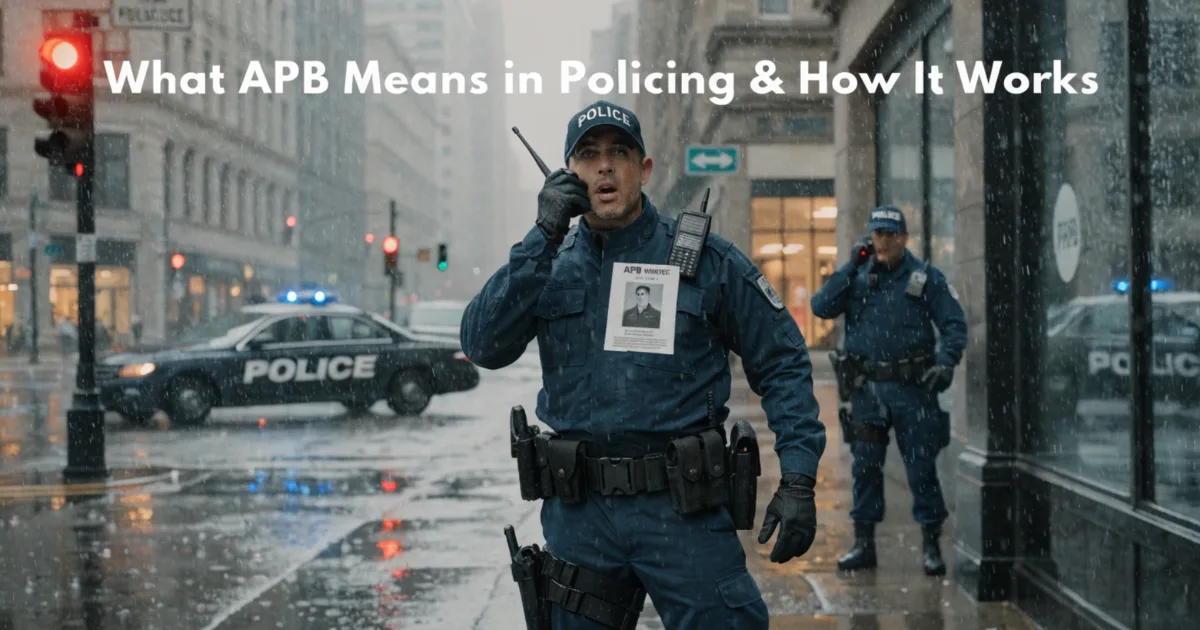
APB stands for “All Points Bulletin” — an official alert broadcast by law enforcement to notify officers across a wide area about a suspect, missing person, or vehicle they need to locate.
You’ve heard it in every cop show. But the real story goes much deeper than Hollywood lets on.
Let’s break it down.
What Does APB Mean and Where Did the Term Actually Come From?
The term All Points Bulletin dates back to the early 20th century.
Before radio, police had to physically pass information between precincts. Slow. Inefficient. Often useless.
Then came police radio systems in the 1930s, and everything changed overnight.
Dispatchers could now broadcast a single alert to every patrol car simultaneously. “All points” literally meant every officer, every post, every direction.
The term stuck — and it’s been part of American law enforcement vocabulary ever since.
How Law Enforcement Agencies Use an APB in Real Police Operations Today
When a serious crime occurs, a supervisor or dispatcher authorizes an APB.
It gets transmitted through:
- Police radio channels
- Computer-aided dispatch (CAD) systems
- Inter-agency communication networks
The bulletin typically includes:
- Suspect’s physical description
- Last known location
- Vehicle details (make, model, color, plate)
- Nature of the crime
- Whether the subject is considered armed or dangerous
Every officer on duty receives it instantly. That’s the power of it.
More Posts:LWK Meaning: What Lowkey Means in Texting
What Triggers an APB — The Specific Crimes and Situations That Warrant One
Not every incident gets an APB. It requires a certain level of urgency.
Common triggers include:
- Armed robbery or assault in progress
- Homicide suspect on the run
- Kidnapping or abduction
- Missing vulnerable person (elderly, child, mentally impaired)
- Escaped prisoner or parolee
According to the Bureau of Justice Statistics, local police departments handle over 10 million serious crimes annually — but APBs are reserved for high-priority, time-sensitive cases.
Speed matters. The first 30–60 minutes after a crime are often called the “golden hour” in law enforcement.
APB vs BOLO vs Amber Alert — What’s the Real Difference Between These Alerts?
People use these terms interchangeably. They shouldn’t.
APB (All Points Bulletin) Broad alert sent to all officers in a region about a suspect or vehicle.
BOLO (Be On the Lookout) Similar to an APB but often more localized. Used when a specific unit or area needs to watch for someone.
Amber Alert Exclusively for child abduction cases. Triggered by strict federal criteria and broadcast publicly — on highways, phones, and radio.
Silver Alert Targets missing senior citizens, especially those with dementia or Alzheimer’s.
The key difference? Audience and scope.
An APB speaks to cops. An Amber Alert speaks to everyone.
How APBs Work in the Digital Age — Technology, Social Media, and Modern Broadcasting
The old radio crackle is just one piece of the puzzle now.
Modern APB systems operate through:
- Integrated law enforcement databases like NCIC (National Crime Information Center)
- Real-time GPS tracking shared between units
- Automated license plate readers (ALPRs) that flag wanted vehicles instantly
- Wireless Priority Service (WPS) for emergency communications
Some agencies now push alerts through encrypted apps similar to Slack — keeping information secure while moving fast.
Social media plays a role too. Departments share public-facing versions of bulletins on Facebook, X (Twitter), and Nextdoor to crowdsource tips from civilians.
The FBI’s tip line integrates directly with active bulletins in major cases.
It’s a far cry from a dispatcher reading into a radio mic.
Common APB Myths Debunked — What Hollywood Gets Wrong About Police Bulletins
TV makes APBs look like magic. Reality is messier.
Myth #1: An APB means instant capture Not even close. It alerts officers — it doesn’t guarantee a result.
Myth #2: One cop can issue an APB on a whim False. It requires supervisor authorization in most departments.
Myth #3: APBs are nationwide automatically Wrong. Most APBs are local or regional. Going national requires coordination through federal channels like the FBI or US Marshals.
Myth #4: APBs are only for criminals Nope. Missing persons, endangered adults, and lost children all trigger bulletins regularly.
Hollywood compresses time and inflates drama. Real APBs are procedural, documented, and tightly controlled.
More Posts:What Does It Mean When a Ladybug Lands on You?
FAQs
Q: What does APB stand for in police terms?
APB stands for All Points Bulletin — a broadcast alert sent to law enforcement officers about a suspect, vehicle, or missing person.
Q: Is an APB the same as a BOLO?
They’re similar but not identical. A BOLO (Be On the Lookout) is typically more localized, while an APB covers a broader area.
Q: Can a regular citizen request an APB?
No. Only authorized law enforcement personnel can issue an APB. Citizens can file a police report, which may lead to one being issued.
Q: How long does an APB stay active?
It varies by jurisdiction. Some expire after 24–48 hours, while others remain active until the case is resolved.
Q: Does an APB show up on public records?
Generally no. APBs are internal law enforcement communications, though some information may become public through press releases or court records.
Q: What’s the difference between an APB and an Amber Alert?
An Amber Alert is public-facing and specific to child abductions. An APB is an internal law enforcement communication covering a wider range of situations.
Conclusion
An APB is one of the most efficient tools in American policing — built on speed, coordination, and real-time communication. Now you know exactly what it means, how it works, and what sets it apart from every other alert out there.

As the admin of https://centomags.com, I craft engaging content that brings laughter, heartfelt wishes, and witty pickup lines. My passion lies in creating responses that connect, entertain, and spread joy across every interaction and occasion.