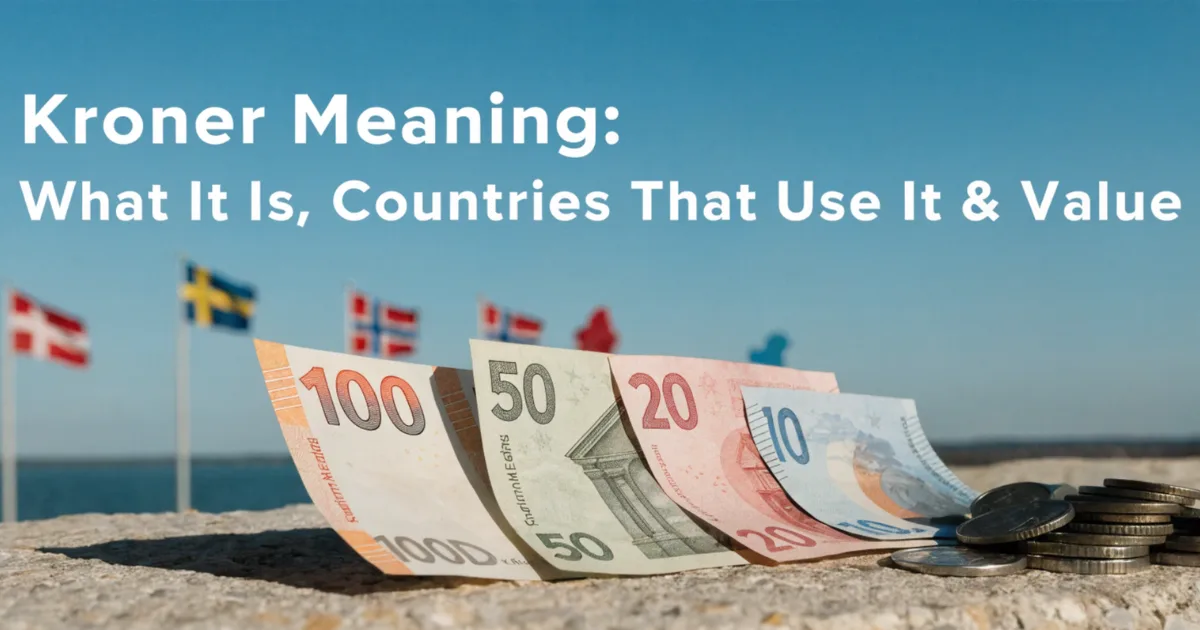
Kroner is the plural form of “krone,” a currency name meaning “crown” in several Scandinavian languages. It is used across Nordic countries including Denmark, Norway, and Sweden.
The Literal Meaning of Kroner and Where the Word Actually Comes From
The word kroner traces back to Latin — corona, meaning crown.
When Scandinavian nations adopted this currency in the 1870s, the “crown” symbolized royal authority and national pride.
Here’s a quick breakdown:
- Krone = singular (one crown)
- Kroner = plural (multiple crowns)
- Kronor = Swedish plural spelling
- Kronur = Faroese and Icelandic variation
The name wasn’t random. Coins back then literally featured the royal crown on their face — a tradition that continues on modern coins today.
More Posts:What Is Yaoi? Meaning, History & Popularity Explained
H2 2: Which Countries Use Kroner and How Each Version Differs From the Others
Several countries use a version of the krone, but they are not interchangeable.
| Country | Currency Name | Symbol | Code |
|---|---|---|---|
| Denmark | Danish Krone | kr | DKK |
| Norway | Norwegian Krone | kr | NOK |
| Sweden | Swedish Krona | kr | SEK |
| Iceland | Icelandic Króna | kr | ISK |
Each is a separate, independent currency with its own exchange rate.
So when someone says “kroner,” context matters. A Norwegian kroner and a Danish kroner hold different values entirely.
Sweden technically uses “kronor” not kroner — a subtle but important distinction for travelers.
H2 3: How Much Is Kroner Worth Compared to the US Dollar Right Now
This is what most Americans want to know first.
Here’s a general snapshot (rates fluctuate daily):
- 1 USD ≈ 6.8 Danish Krone (DKK)
- 1 USD ≈ 10.5 Norwegian Krone (NOK)
- 1 USD ≈ 10.3 Swedish Krona (SEK)
- 1 USD ≈ 138 Icelandic Króna (ISK)
The Norwegian krone is the most watched by investors due to Norway’s oil-backed economy.
The Danish krone is uniquely pegged to the Euro — making it one of the most stable Nordic currencies.
Always check live rates on platforms like Google Finance or XE.com before any transaction.
More Posts:Chisme Meaning: More Than Gossip in Latino Culture
H2 4: Why the Kroner Matters to American Travelers, Investors, and Forex Traders
For American travelers, understanding kroner means avoiding airport exchange rip-offs.
Airport kiosks often charge 10–15% above the market rate. That’s money straight out of your pocket.
For forex traders, the Norwegian krone (NOK) is especially interesting because:
- It moves with global oil prices
- Norway holds one of the world’s largest sovereign wealth funds
- It’s considered a commodity-linked currency
For investors, Scandinavian economies consistently rank among the world’s most stable. The Danish krone’s euro peg makes it a low-volatility option worth watching.
Even if you’re just planning a trip to Copenhagen or Oslo, knowing the real exchange rate saves you real money.
H2 5: Common Mistakes Americans Make When Dealing With Kroner Exchange Rates
Plenty of Americans get tripped up. Here’s what to avoid:
Mistake 1: Assuming all kroner are equal Danish, Norwegian, and Swedish currencies are completely separate. Spending Norwegian krone in Sweden won’t work.
Mistake 2: Using airport or hotel exchanges These charge steep fees. Use your bank or a fee-free travel card instead.
Mistake 3: Ignoring dynamic currency conversion When a card machine abroad asks “pay in USD or local currency?” — always choose local currency. The USD option hides inflated rates.
Mistake 4: Not notifying your bank Many US banks flag Scandinavian transactions as suspicious. A quick call before your trip saves frozen card headaches.
Mistake 5: Confusing “krone” with “kroner” In conversation and on menus, locals often use both forms. Don’t let the spelling variation confuse your budget math.
More Posts:Carino Meaning: Spanish & Italian Word for Affection
H2 6: Practical Tips for Buying, Converting, and Spending Kroner as an American
Getting kroner doesn’t have to be stressful. Here’s what actually works:
Before You Travel:
- Order DKK, NOK, or SEK through your bank at least a week ahead
- Open a Wise or Revolut account for near-interbank exchange rates
- Check rates daily using Google’s currency converter
While You’re There:
- Use local ATMs connected to major networks like Cirrus or Plus
- Pay by card wherever possible — Scandinavia is nearly cashless
- Keep small kroner amounts handy for markets or small vendors
For Forex or Investment Purposes:
- Track NOK against USD if you follow oil markets
- Use platforms like Interactive Brokers or OANDA for trading Nordic currencies
- Watch Norway’s Norges Bank rate decisions — they directly move NOK
Scandinavia is expensive by American standards, but smart currency habits stretch your dollar further than you’d expect.
Conclusion
Kroner means “crowns” — a currency rooted in royal heritage across Nordic nations. Each country’s version carries its own value, and knowing the difference saves you money. Whether you’re traveling, trading, or just curious, understanding kroner puts you ahead of the crowd.
FAQ’s
What does kroner mean in English?
Kroner means “crowns” in English, derived from the Latin word corona. It refers to the currencies used in Scandinavian countries.
Is kroner the same as the euro?
No. Kroner is not the euro. Denmark, Norway, and Sweden have kept their own currencies and are not part of the Eurozone.
Which country uses kroner?
Denmark and Norway officially use “krone/kroner.” Sweden uses “krona/kronor.” All are separate currencies with different values.
How much is 1 Norwegian krone in USD?
Roughly 1 NOK equals about $0.09 USD, though rates change daily based on oil prices and market conditions.
Can I use US dollars in Scandinavian countries?
Generally no. Most Scandinavian businesses only accept local currency or major credit cards. Always carry or access local kroner before you arrive.

As the admin of https://centomags.com, I craft engaging content that brings laughter, heartfelt wishes, and witty pickup lines. My passion lies in creating responses that connect, entertain, and spread joy across every interaction and occasion.